
Questionnaire: Petr Tuček
- Narrator's name
- Petr Tuček (PT Petr Tuček)
- Year of birth
- 1970
- Place of birth
- Praha
- Interview date
- 4. 5. 2026
- Interview language
- Czech
- Project
- Creators from the 80s
- Publication date
- 17/09/2026
- …of English translation
- 17/09/2026
Petr Tuček - born in 1970 in Prague - is the creator of several small games for the ZX Spectrum from the late 1980s, which we digitized in 2026. Currently, the narrator works as a software analyst. The interview is accompanied by screenshots of the narrator's games.
And then came another turning point. The first computers started appearing among people. Back then there were three: Atari, Commodore and the ZX Spectrum. The last one was the most popular, and that's the one I eventually bought from a kid my age on the estate. He was apparently from a family that traded computers on the black market; it wasn't cheap, and on top of that he started pushing the agreed price up at the last minute – I assume his parents advised him to. Still, he was fair about it, came over to set it up and show me how it worked, and copied me a whole cassette of games and programs right away. My parents weren't at all thrilled about the computer. You could say it significantly changed how I spent my free time. From then on I sat at home and spent my time at the computer.
I remember how the ZX Spectrum fascinated me with its compactness – the size of an A5 notebook, with rubber keys that fit all the commands through three different Shifts. But there were some problems that came with it. The first was the television. Of course I couldn't use the family colour TV in the living room, so my dad brought me a discarded black-and-white TV from some acquaintances. The second complication was the tape recorder, which we didn't have at home. I had to borrow a cassette player from a classmate, and only later did I buy a proper one of my own at Tuzex. The third pitfall was working with the recordings themselves. A lot depended on the quality of the recording. If you were creating something yourself, you had to back up constantly, find space on the tape, and write everything down.Then came another expansion. A single-pin printer. I got one, and suddenly it meant I was able to print: texts, pictures. I started creating fonts for this printer, but most importantly the computer started to have a practical use – I could write or print something for my parents.
At secondary school we also had programming as an elective subject. It was still in its infancy back then, so it was quite laughable. The school got IQ 151 computers. Fortunately, a classmate arranged for us to be in the club's premises at Flajšnerka instead of the school classroom. It made the classes more bearable, and I remember how we were helping our female classmates grasp the principles after they had overestimated their abilities when choosing the elective. It's true that we also learned our first algorithms and some logic of programming tasks, which is more about overall effect and logical thinking than about deepening one's knowledge of programming itself.
- A short loader program in Basic that quickly displays the program name on the screen and loads the rest.
- An image drawn in the professional program ArtStudio and converted, using a program available at the time, into executable code that renders the image gradually, square by square.
- Intro music composed in the professional program Wham! The Music Box, which was capable of two parallel sound voices by rapidly alternating between two sound lines, and exported as executable code.
- The necessary code, typically user-defined graphics characters (8 x 8) for elements, or an entire alphabet, or data for room layouts, or entire sections of code written in assembly.
- The main service program, again in self-executing Basic, which operates the given program.
Logos of all kinds were also in fashion back then, so we used them on the title picture. Mine is the three layers with an arrow – I probably couldn't make up my mind, so it's turned a different way each time. I collaborated with friends, and each of them had their own logo too:
- Roman Žák, a classmate from primary school and an enthusiast for the technology of the day. He drew almost all the pictures for me. He brought them to me drawn on squared paper, where he had shaded in the individual pixels with a pencil, and then he was there when I redrew them in ArtStudio. His logo is the one with the two set squares.
- Jan Špaček, a classmate from primary school, who played the piano at the time. I brought him ideas for music and he wrote them out for me as sheet music in two voices. Then I transcribed them in Music Box. I assigned him the musical note logo.
- Michal Zintl, a classmate from secondary school, who had his own ZX Spectrum at the time, but only for gaming; nevertheless, he collaborated on ArtHudba. I insisted that he creates his own logo too, so he drew the "Old Town Tower".
- Michal Žampach, a classmate from secondary school, who was programming in assembly at the time, but wasn't very keen on collaborating, so he only supplied me with a few technical components.

Housenka (Caterpillar)
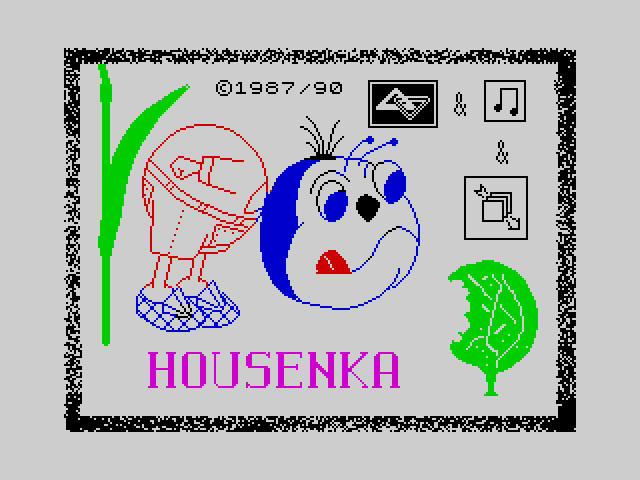
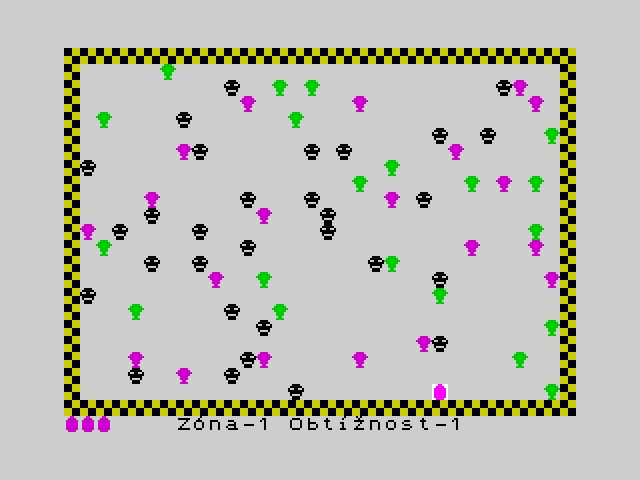
Roman Žák came up with the theme of the game. It was the first program I created. I kept tweaking the game for a long time, and I believe the idea comes from Pac-Man. Roman simply liked something that eats. The caterpillar moves through a maze, and the further levels are about both complexity of the maze and the speed of movement. Roman came up with the idea that it would be a worm that gradually gets longer by collecting cabbages. As in Snake, it also has to avoid obstacles, which here take the form of skulls.
It's written in Basic. At the start, both the cabbages and the skulls are placed randomly. The cabbages come in two colours. The purple one is more nutritious: you grow more from it. The problem was that once a cabbage is eaten, new cabbages need to be added, but as the maze fills up, the random number function slows down. So I chose a different method: instead of generating them randomly, I created cabbages out of the skulls, which also solved the problem of skulls piling up somewhere and blocking a passage. And new skulls appear behind the caterpillar. Little piles of droppings appear behind the caterpillar too – that's an extra joke.
Here, exceptionally, the music wasn't my idea; I think Jan Špaček himself brought me a rock'n'roll piece he had written. The music that beeps during the game is there to slow things down. I think Michal Zintl brought it to me as sheet music, and I naively thought it was so sophisticated, but it's just chords broken down into individual notes going up and then back down again.
Download the game HousenkaNádražák (The Railwayman)
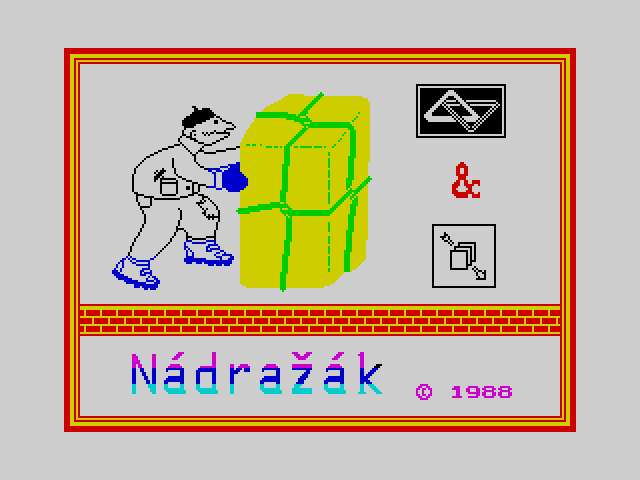
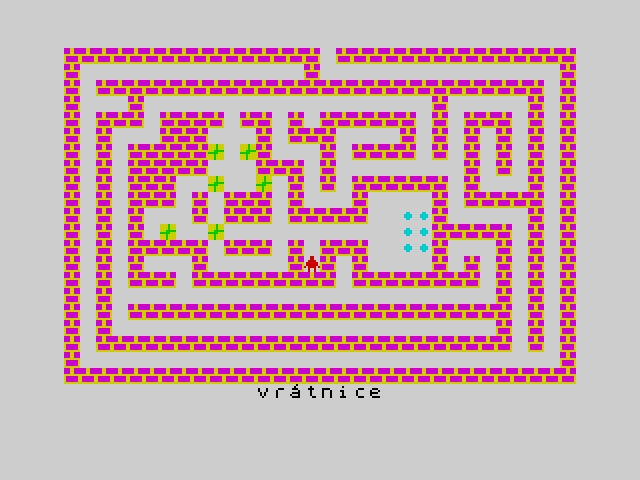
In the second year of secondary school we were on an internship. There wasn't much to do there, so we went to see classmates who had a Commodore computer with games. And that's where I saw Sokoban. I copied down all the levels, and that's how the idea for the game Nádražák ("The Railwayman") came about. I wasn't satisfied with a mere copy. At the time I was fond of mazes, so everything is set in a very complicated maze connecting the individual rooms. And I was also fond of the songs of Šíp and Uhlíř. So the theme and the name are derived from the song "Šel nádražák na mlíčí" ("A Railwayman Went Out for Fish Milt"). That's why the individual rooms are from a railway station building and its surroundings. The intro song is that very one. The game is again programmed in Basic.
Download the game NádražákBusiness
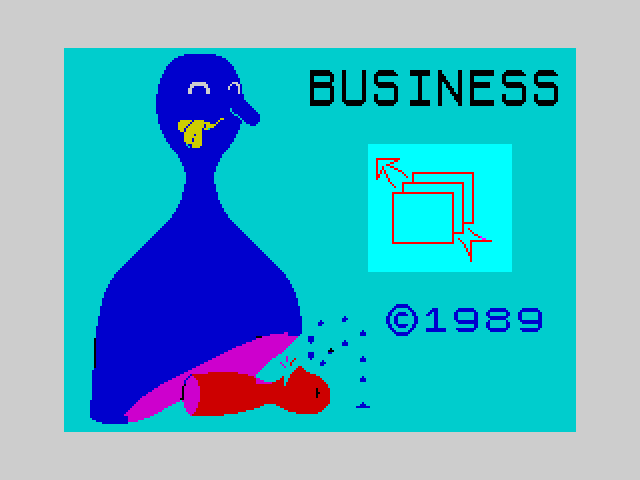
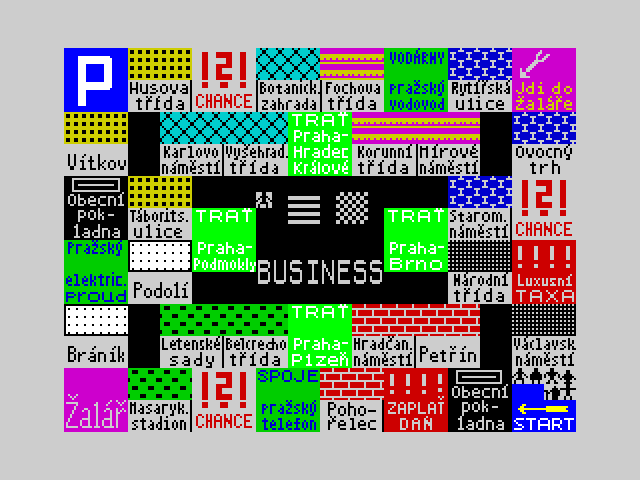
The game is again programmed in Basic and is inspired by Monopoly and its Czech variant, Dostihy a sázky ("Horse Racing and Betting"). We often played it at home, so I drew on it when making my next video game. So that was the next idea. It's practically unplayable, because converting it into a computer game isn't a good idea. The intro song is "Zelená vlna Hvězdy" ("Radio Hvězda's Green Wave"), sung by Luděk Sobota.
Download the game BusinessŠkolák / Školní akce (School kid / School action)
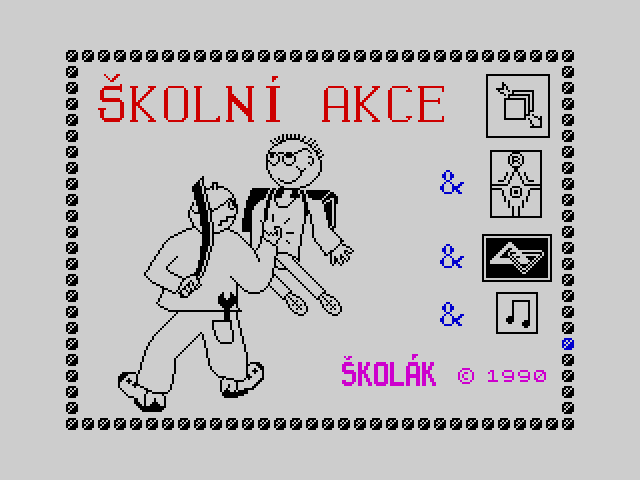
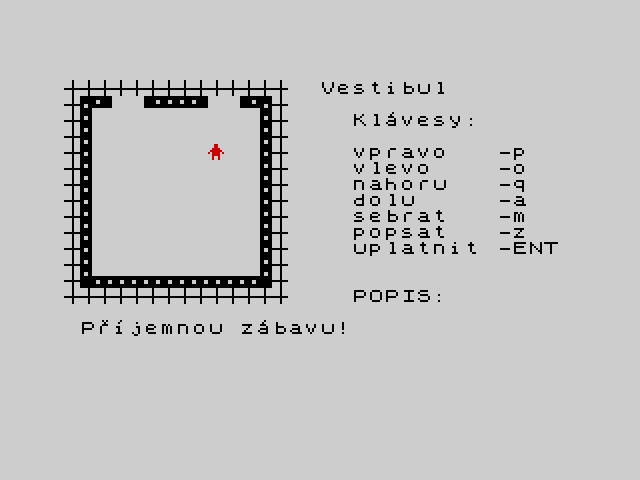
That was another year of internship, another encounter with a game on the Commodore. This time a classmate was playing an exploration game of sorts, where you walk around a maze, look for something, find it, carry it somewhere else and use it. The setting is our own school, the then Gymnázium Vysočany. The individual rooms are drawn and stored as data. They're displayed magnified 4 times. Martin Žampach programmed the display for me. For each room, 4 different hint texts are shown (the room is divided into 4 sectors). Two are constant and appear in all rooms; two are variable, different for each room, and they hint at what's supposed to happen. The intro song is "Meliorační" ("Land Reclamation") by Šíp and Uhlíř.
Download the game ŠkolákArtHudba (ArtMusic)
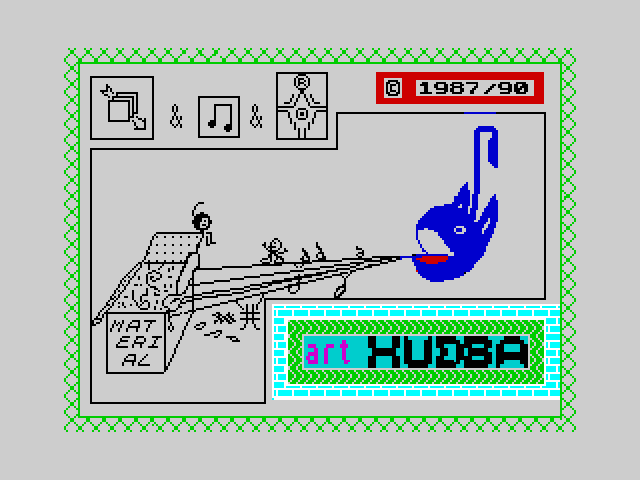
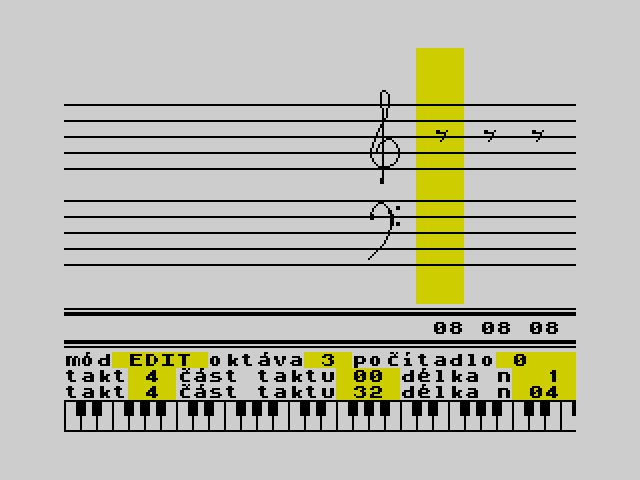
The name is a play on ArtStudio. The idea came from my secondary school classmate Michal Zintl, who also took part in making it. We liked the professional program Wham! The Music Box, which had one shortcoming: the music could be played, but it couldn't be used while a program was running. So we wanted to make a similarly user-friendly program for working with the Basic command BEEP, which is normally unintelligible. We fine-tuned the look of the program together; the keyboard handling and the output I then did on my own. We drew the title picture together – ArtStudio allowed merging two pictures into one, so we combined the parts each of us had drawn.
Download the program ArtHudbaPredit (Professional editor)
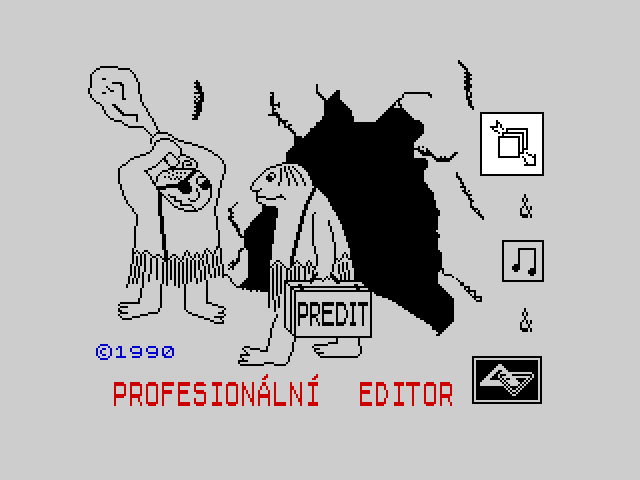
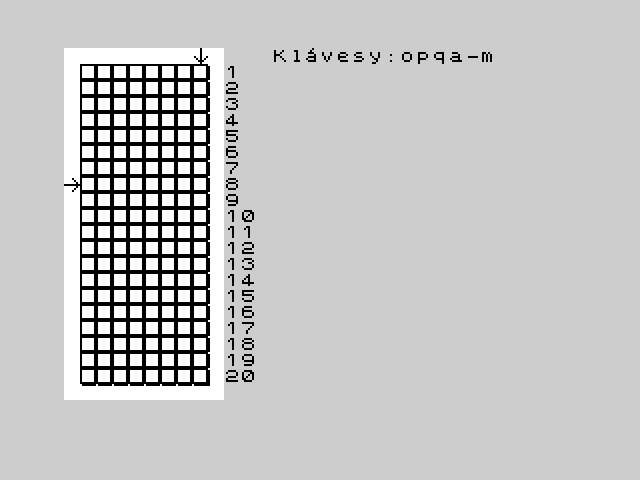
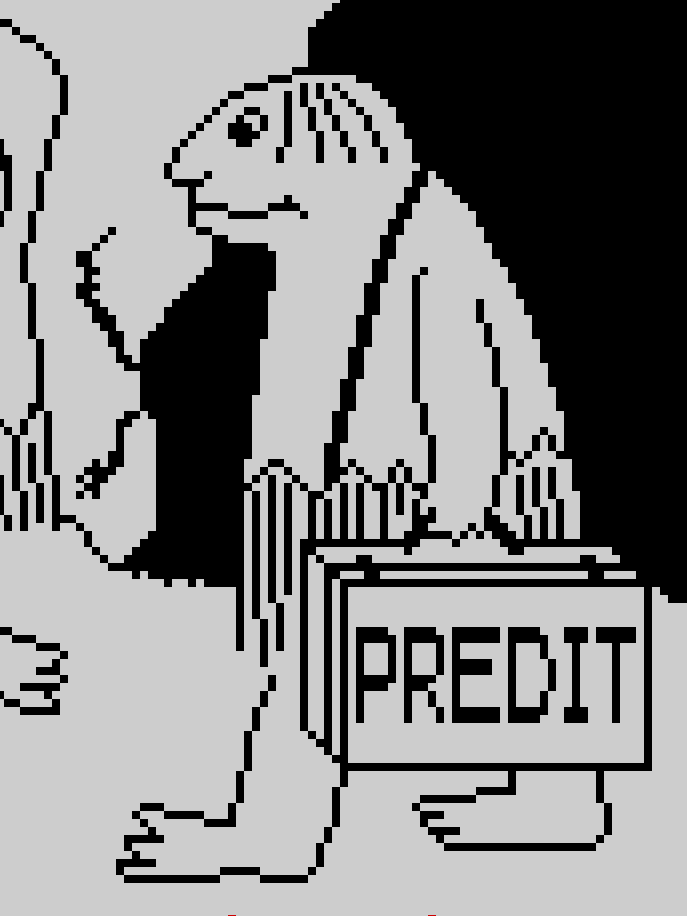
In all the programs mentioned above, I needed to draw characters and objects in the 8x8 character format. On the ZX Spectrum, these are stored in so-called graphics characters kept at the end of memory. At first I wrote a simple editor for that, which I called Grazny. Then printers came on the market – the single-pin BT100. And for those… that was another expansion, whole alphabets had to be defined. So I extended the original Grazny to allow drawing a whole alphabet and even choosing the grid size. I think the main program is Basic compiled into assembler.
The ZX Spectrum's memory was limited after all, so from the beginning there were efforts to make the programs smaller and faster. I was learning assembly and tried programming in it. But that wasn't the right path for me, and in the end I looked for other ways of working. One of them was Basic-to-assembly compilers, and the other was the help of my classmate Martin Žampach, who made several usable routines for me.
Download the program PreditItems
Loading...
This interview is part of the project Creators from the 80s.