

Škoda's promotional adventure game, or "Don't disturb my circles!"
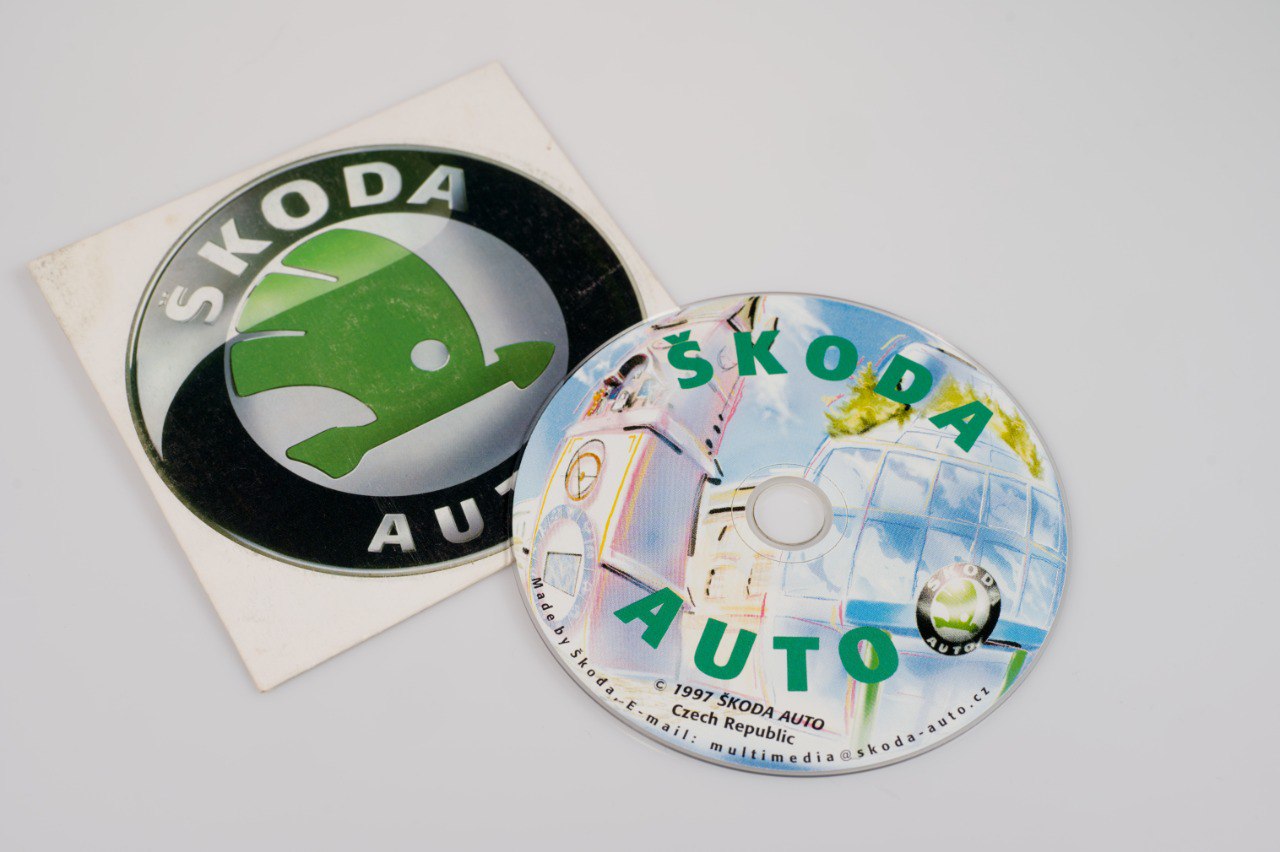
In 1997, the automobile manufacturer Škoda released a promotional CD-ROM that combined standard marketing materials with an interactive interface similar to point-and-click adventure games. There's no apparent attempt to create a narrative, so users can only aimlessly wander through a virtual version of a hybrid of Prague and Mladá Boleslav that looks like it came straight from a contemporary clip art library. Users can travel through time to explore the history of the car manufacturer or visit a 3D-rendered car showroom. It's a truly peculiar piece of media history, the very existence of which begs the questions: Who is supposed to be the target audience? And why was this CD-ROM even created?

The 1990s were a period of relentless innovation in consumer technology. The Internet, bringing with it hypertext and standards like HTML and VRML, saw a surge in users even in our country in 1997, but still only about 2% of households had internet access.[1] Distribution of catalogs and marketing materials therefore also used physical media in the form of data compact discs. Although CD-ROMs were far from new technology, falling costs of CD pressing in the second half of the 1990s made it very easy to distribute large volumes of data into users' hands without them having to pay for internet connections. This may explain the boom of "interactive multimedia CD-ROMs" that combined the technological idealism of their era into a sort of CD-ROM bubble. In this context, we probably shouldn't be surprised that Škoda Auto also produced a promotional CD, but what's harder to explain is its content.
The first thing you'll see after launching is a promotional video featuring various Škoda car models, interspersed with clips of rally races, work in the assembly hall, and Prague monuments. Eventually, the video transitions directly into an interactive scene that's controlled much like typical point-and-click adventures. While Smetana's Vltava plays in the background, before our eyes stands the Old Town Hall tower, next to which is a modern Škoda showroom. The automaker is thus conspicuously presented as something sheerly Czech. Perhaps in response to joining the Volkswagen Group, which by this time already owned the majority of its shares?
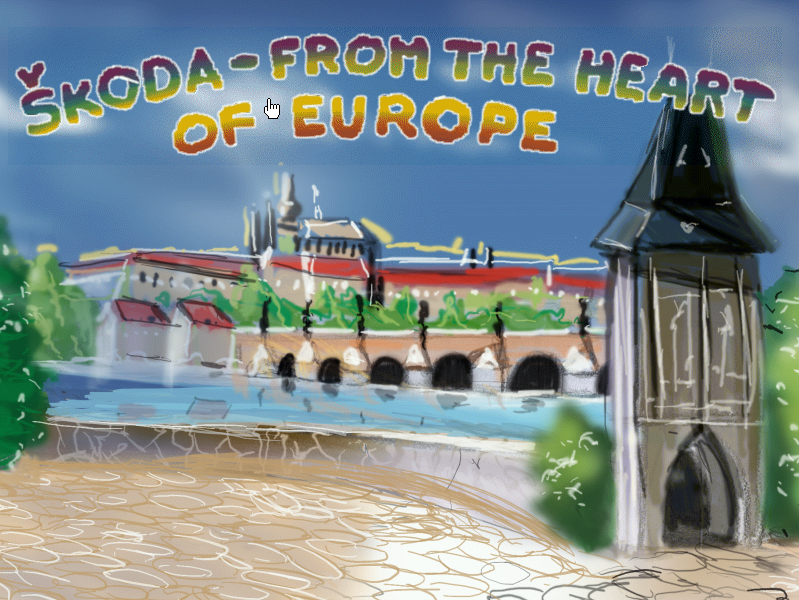
At this point, we can freely explore various Prague landmarks, among which, for some reason, is also the Škoda M13 assembly hall in Mladá Boleslav, which was freshly completed at the time. Upon clicking, the M13 hall starts to expand accompanied by breathing sounds, until a newborn car drives out into the world. The nearby National Theatre, when clicked, either plays a video informing us that Škoda invests in culture, or a slideshow promoting the automaker's Mladá Boleslav museum. Clicking on the Astronomical Clock allows us to travel through time back to 1900, when a Laurin & Klement branded building stands in the Old Town Square. Time travel allows us to play short clips about the history of the Škoda brand with English commentary. Furthermore, for example, a telephone booth rings upon interaction, whereupon a spider (aptly fitted with Škoda Auto branding) appears on the screen, covering the entire screen with a web, before an offline version of the Škoda website opens in a browser. If I understand this metaphor correctly, we just connected via telephone modem to the internet's web…
When I got my hands on this CD-ROM as a child, I couldn't help being fascinated. I wasn't consciously aware of its marketing rhetoric and just enthusiastically went through the various screens and explored everything I could click on. Maybe it's nostalgia, but this CD managed to capture fascination with new technology and convey it like few contemporary marketing efforts. Although I know it certainly wasn't, I felt as if this corporate mini-adventure was created for my five-year-old self. But who was the actual target audience? The omnipresence of English suggests it was a PR tool for abroad. Most of the content isn't focused on regular press releases or market data, so I doubt they were targeting business partners and dealers. With all its interactivity and playfulness, it's most likely a product aimed at ordinary people. If this CD was meant to reach potential customers' hands, it would make sense to present themselves with their history and "Czechness" to help establish a clear brand identity. But then why would they give users the ability to travel through time all the way back to the year 1100?
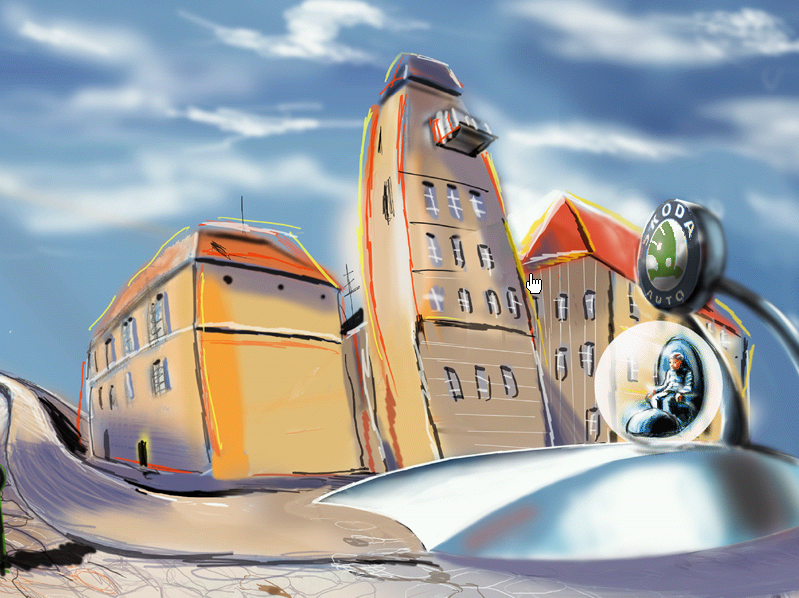
After traveling via the Astronomical Clock to the year 1100, we find ourselves before a palisade, which upon interaction plays a clip from some black-and-white film about Hussites (they missed by a few hundred years). Nearby, we also encounter milestones that play a similar clip with scenes from everyday life in the Middle Ages. Does Škoda's history reach this far back? On the other hand, we don't have to travel only to the past. After moving to the year 2100, the Škoda showroom transforms into a fountain and the cars being produced in the M13 hall in this utopian future are chairs enclosed in transparent spheres. Upon returning to the (at that time not-so-distant future) year 2000, we can also encounter my favorite absurdity in the form of a manhole cover, which when clicked opens and from the bowels of the sewer emerges a dark figure with the words: "Nōlī turbāre circulōs meōs!". Why a random sewer rascal is shouting Archimedes' last words (Don't disturb my circles!), remains a mystery to me. I don't know if I'm just missing some reference or if the developers' real goal was to spread confusion and chaos.
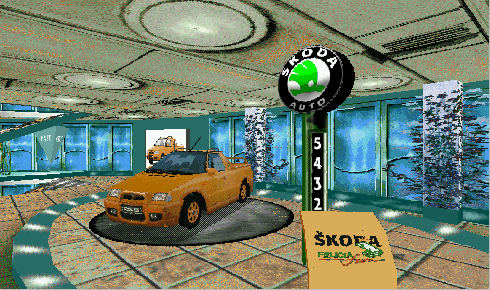
Surprisingly, you can also encounter sections rendered in 3D. The first of them is a racing game where the player faces off against a red Škoda Octavia. It's a very simple minigame with straights and turns à la Pole Position, but surprisingly, you don't drive the same race every time you start. The track and its surroundings are probably always randomly assembled, so clearly the developers cared about replayability. The second part of the CD-ROM that uses early 3D graphics is the Škoda showroom itself. It's a five-story building where you can move between floors using escalators with flower textures. On each floor, you'll find a 3D model of a car on a turntable, with a different model on each floor. You can look at the technical specifications for each of the models, but that's all the showroom offers.
I think there really is no other era from which such a creation could emerge. The late 1990s, when buzzwords like "multimedia" and "interactivity" had much more impact on whether you'd get funding for your crazy project compared to today. So who was tasked with developing this work? The so-called Multimedia Team Škoda (hereafter MM team). It was a team assembled from nine designers, programmers, and artists, along with six additional web developers. I couldn't find much information about everything the MM team worked on, but from available sources, they were responsible for the brand's websites and these CD-ROMs. I deliberately used the plural because there are mentions online of other discs that were meant to promote specific car models from Škoda. I don't know if they're anywhere near as elaborate as today's subject, but either way it says a lot about the MM team. A bunch of creative people at the intersection of marketing, PR, IT, and gamedev. Within a few years, the rhetoric associated with new technology began to change, and around the same time, the last mentions of Škoda's MM team also disappear. Whatever the fate of the MM team, one thing is clear – they never returned to creating quirky promotional software, and the most unique thing that came from their office has now been archived to this day…
Items
Loading...
- [↩] What was the Internet like in 1998?, Jiří Peterka, earchiv.cz
Blog posts from Jakub Škrdla
Jakub is a gamer fascinated by the strange corners of game history, and a game researcher focused on environmental storytelling. He is currently pursuing a PhD at Masaryk University; should you meet him there, he would be happy to chat about art games and level design.